Showing posts with label philippines. palawan. Show all posts

21 November 2008

Outside, In Front


One breaks against the wind, the other against the fatigue of the red-eye bus trip from Puerto to El Nido. Wide open spaces, I miss you.

05 October 2008

Saliva Soup


"Quality A" little bunches of bird spit.

In China (and Chinatowns and Chinese territories), you will find, in health shops, expensive packets of birds' nests being sold. They are used to make soup that apparently balances the body's constitution.


Ronnie, our caretaker. Also a busyador (nest gatherer).

Seeing these in Macau and Hong Kong made me think of my recent trip to one major nest source, the El Nido group of islands in Palawan. The place had been visited by Chinese traders as early as the Sung Dynasty (mentioned in books more than one century BC!) owing to the abundance of resources such as the small bowl-like formations of hardened swiftlet spit found in the caves.

This paradise was called Pa-Lao-Yu or "Land of Beautiful Harbors" by the Chinese, and named El Nido or "the nest" by the Spanish.


El Nido cliffs.

Among these jagged and beautiful limestone cliffs and mountains of El Nido are caves where bats and swiftlets or balinsasayaw abound. There are views that nest collection is endangering the birds. People often to collect beyond the prescribed period. as the thing commands exorbitant prices on the market. Creating any kind of shelter or useful thing out of bodily excretions is indeed a talent, which we shouldn't ever lose to commerce.


Here are some, on a spinning plate. That really cracked me up.

20 August 2008

Bring The Mountain to Mohammad


Bus to Dumaguete, selling pomelos and snacks.

Many people in small towns take advantage of bus routes by preparing pre-packaged or portioned food that can be bought in a total of 5 seconds (through a window).


Bus to El Nido, girl selling corn.


Bus to Benoni, selling guavas I think?

11 August 2008

A Bit of Carinderia Love and History


1875 illustration of a carinderia in El Oriente newspaper.

I love carinderias. Whilst on long-haul buses I have a Pavlovian hunger-related reaction towards food stops. I like eating my way across the varying landscapes. Or, if there are no veggies or I'm oddly full, I poke around at everything-- what their bathroom signs say, what utensils they use, how the places are laid out, what language the people speak.


Wide selection of food in Puerto Princesa-- and this is only on the left side of the door!

These places prove that prepared food does not have to be soul-less like they are in many commercial restaurants. In smaller towns, they are a place for community to gather, like the Western coffee house. There you get free soup and the ability to make your own sawsawan (I prefer vinegar with siling labuyo broken up into it). If you sit in long enough you will also overhear stories about other locals from the patrons and the owners.


Communities can use less firewood if they cook in larger amounts, in this rural Batangas place.


Coming out to say hi.

Carinderias became widespread in rural areas only after increased human mobility, around the late 1800's. Before this, I picture people simply setting up large pots by their windows or in front of their houses, much like in more "isolated" areas today. People come walking over with bowls from their homes and buy a bit to take home.


Jackfruit (langka) with coconut milk sauce (I poured it all on my rice), standard carinderia fare.

Felice Prudente Sta. Maria notes that carinderia is most likely derived from the word cari or kari, a Tamil word for sauce, or a saucy accompaniment to rice. Some theories attribute this connection to the large number of breakaway soldiers from the invading British army, mostly East Indian Bengalis or Tamils, ended up settling in Taytay and Cainta, major tourist routes at the time. Note: I don't buy this theory of word origin.


Good ventilation at a bus stop to El Nido.


Even better ventilation at an outdoor carinderia.

Most memorable of their offerings was spicy cari (it has been posited that our peanut stew kare-kare had evolved from this East Indian-Javanese dish). However, their enterprises, primarily catering to some locals and many tourists from pilgrimages and train journeys, served things from food, tobacco, water, and alcohol. Notable was the serving of betel nut, much like India's paan stalls.


A simple layout in Dumaguete.

Over time, the stalls evolved to serve solely food-- indigenized Chinese dishes, Filipinized Spanish food, and these days some more Western-evolved creations (recently I saw a strange creation-- breaded and deep-fried hotdog wrapped in a pizza). Still mostly saucy and all, to drench your rice with. They still serve the cheapest and most abundant food. That they are moving away from serving regional plants and animals, are an indication that local, unique food is no longer cheap and widely available.


Pinakbet and Chinese-influenced pancit in Camiguin.

25 July 2008

Puerto Princesa's Little Declarations

How do peoples' decals and stickers represent their general approach to other human beings?

This guy selling Yakult was really friendly, open, and had a crinkle-eyed smile:

"I really Like You!" sticker on a Yakult vendor's cooler (may rosas pa).

This trike driver was a shady guy trying to rip us off in an unprecedented manner:

"Sorry!! Di kita type" button in a trike.

04 July 2008

Even More Fluff

Stuffed toys in public vehicles: do they demonstrate a force opposing driver machismo, or a strange harmony of attitudes and elements within a seemingly tough subculture?


Barney and friends in an El Nido trike.

30 June 2008

The Dogs of Palawan


Bearded dog at Snake Island.


Hungry twins at Snake Island.


The demon staring puppy of the El Nido playa.


Wood-eating dog in El Nido town.


Dog in town. Not attracted to our stone.


Obese small dog in Puerto Princesa.

26 June 2008

It's Nice To Be Back


OFW siguro.

Good Flowers and Weird Food

The rose has achieved global domination through centuries of symbolism and dripping poetry. There is an amazing irrationality to its ubiquity (along with the truckloads of chemicals needed to grow it in tropical countries).

That's why spontaneous little arrangements with who-would've-thought flowers like these are so encouraging:


Caballero, lantana, and other common flowers in a centerpiece at Daluyon Resort, Puerto Princesa.

Seeing these things pushes us to create small celebrations everyday! So set out a bowl of boganvilla or calachuchi on your table now, and all the time.

However, the same restaurant doesn't carry this practice over onto its food, as it served me a horrible dish, which was hilarious on several levels.

It was made with corn and mushrooms and carefully placed on a bed of lettuce. Nothing was grown locally, nothing spoke of the location. The funny part comes when you realize that you are about to eat actual pieces of white bread that have been cut into squares and made to look fancy. Couldn't they have made it a baked or deep-fried very thinly sliced kamote or something? It was also drizzled with some kind of really thick dressing.


The food was insanely expensive, maybe 200 to 300 pesos per dish, for pretty substandard ingredients. I was very much aghast. Just one tip for the owners: just because something is arranged on a bed of something, in a small serving, piled one layer atop another, and drizzled with something, doesn't mean it will taste good.

Funny.

Daluyon Beach and Mountain Resort
Sabang Beach, Puerto Princesa
(+63927) 316 5513

24 June 2008

Ka Lui


Mango-pomelo shake. Score!

When I'm in the province, I usually veer away from restaurants that seat more than twenty people. Such places usually eschew the amazing diversity in Philippine vegetables and go with the ubiquitous and horrible chopsuey that has invaded our islands. Because the vegetables used in them (broccoli, cauliflower, cabbage, etc.) are more expensive, they are presumed to be more "high class" than the lowland pinakbet sort. It is sad indeed, and I have spent many sad nights sipping sugary mango shake while dreaming of something other than a mediocre cornstarch-laden excuse for a meal.

Life is good, then, when you discover a place like Ka Lui in the heart of a small city like Puerto Princesa.

Ka Lui is named after its owner Lui (Ka is an appellation that Filipinos use when referring to an elder, from the word kapatid or sibling). Everyone who's been there will, without fail, mention something like "I love the ambiance". It's all bamboo and wood, with native and natural decor. It's all tastefully thrown together, and the end-result is different from all the other places informed by their island-ness.

As you enter, you are asked to remove your shoes. Be sure to put them somewhere conspicuous-- as the place gets packed, footwear accumulates at the entrance! Inside are areas where you can eat from the floor, as well as plenty regular tables. The staff is extremely attentive and well-trained.

Ka Lui serves only seafood and vegetables, with no processed sweets and softdrinks. Only recently did they start producing printed menus for their diners. Ah! Seasonal peepz! A good indicator of a good restaurant.


Suka (vinegar) and toyo (soy sauce) at the table.

I first had the lato salad. When I was a child, I thought that these "grapes of the sea" were octopus eggs and regarded them with a sort of awe and fear. They turned out to be Caulerpa racemosa, a seaweed with little sacs that don't taste like grapes at all, but are pretty much filled with seawater. Eating them is all about texture and consistency-- they pop in your mouth like caviar! The usual vinegar or calamansi dressing complements the salty nature of lato.
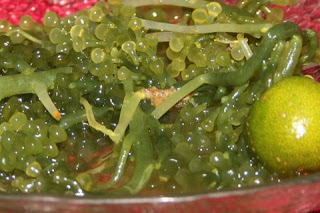

Nobody should ever miss a chance to eat fresh lato.

Next I had pako or fern tops sauteed in garlic, ginger, and peppers. This was surprisingly flavorful. What a simple dish!


Gingery pako.

The highlight for me, though, was the ridiculously delicious mango-pomelo shake. A good departure from the regular mango version, this is something I'll try at home very soon. A slice of ginger in the blender would render this drink as perfect.

Dessert was fresh fruits served inside a buko or coconut shell, and sprinkled with mascobado sugar. You can scrape the meat out of the coconut and eat it, if you're not full to the point of indigestion yet.

Ka Lui
369 Rizal Avenue, Puerto Princesa, Palawan
(+6348) 433 2580

23 June 2008

A Culty Meal at D'Christ Canteen


Strange eating.

On the road from El Nido to Puerto Princesa. The scenery is beautiful, but eight hours inside a suspension-less bus (on worn cushion seats) can never be completely fantastic without some food and stretching in between.

D'Christ Canteen (and don't forget the "Food Haus" in parentheses to further clarify the nature of the establishment) looked quite a bit extensively decorated for a roadside food stop.


The entrance to D'Christ has a Chinese folding ornament and a curtain of wooden beads.


Colors drape the ceiling and a flowery "Welcome" looks on you as you order.


Happy dogs in a wheelbarrow thinking "Happy Dogs!!".

Where do I start? As you mull over the fairly typical food selection, you will probably wonder a bit about the carinderia's name. But religious persons are so common in the Philippines, especially in the province, that you don't spend much time on the thought. But the nagging elements persist in the background of your mind (just like the excessively colorful decor calls out from corner of your eye).

(Rob and I shared a plate, my side containing the standard pinakbet and his, some kare-kare. It was good and cheap.)


Sitaw and kalabasa in the pinakbet. I like drinking out of old Nescafe jars.

On your way out you'll spot a laminated piece of plastic finally explaining the unusual vibe in the place. Apparently, the yellow sign outlines a prayer revealed by "Father Lahi, the ultimate teacher of the final salvation and the author of this ultimate round the clock red priority great warrior power password". It is for the use of the church of "Back to Christ Royal Family in the 7th Millenium".


Click on the photo to read the whole prayer.

The prayer goes on to talk about how Jesus saves us from all dangers such as earthquakes, fire, lightning, flood, storms, tidal waves, smoke poison and sudden death. It's a pretty engaging read.

So you'll get back on the bus wondering if there is some weird energy in your food. You wonder if Father Lahi was serving your meals. All sorts of people round here indeed.

D'Christ Canteen (Food Haus)
Barangay Maoyon, Puerto Princesa, Palawan

20 June 2008

More Snacks

Some more snacks from Palawan:

Bandi is a bunch of cashews cooked in sugar, usually raw sugar or panucha. It's like peanut brittle except not peanuts, and without the oil. I can eat loads of these things, especially when they are fresh. You can get them all over El Nido, and in some places in Puerto Princesa.


Bandi, 5 pieces for 20 pesos.

This variation of hopia was bought at the roadside during a bus stop. I asked the lady what the filling was-- munggo or baboy? She looked at me puzzled and said that it was just hopia filling. I discovered this to be more flour with grated coconut and margarine. Needless to say, I didn't finish the thing. It was pretty tasty, but margarine is gross!


Hopia for 3 pesos.

Maja blanca, the rice flour pudding-like snack, came about after the Spanish came, as evidenced by the name. As this kakanin is supposed to be white, it uses white sugar... too bad, but still tasty. In some places, they use water buffalo's milk, but this particular one used coconut milk.


Maja blanca at 5 pesos a piece.

19 June 2008

Going Bananas

We often joke about how bananas in the global north are not really bananas at all. Often grown and picked with long shipping hours in mind, they are large, perfectly yellow, and taste like flavored cotton or clay. Those with soft skin or black spots are rejected, leaving out any possibility for a tasty banana.


The red bananas of Palawan.

I am not such a fan of bananas (even the small local good ones), but I love the saba variety. These are large, fat, thick ones, that are very filling and are a common mid-day snack for us.

Although you can eat them raw, they are usually cooked. Sometimes they are boiled and eaten just like that, or then mixed with some syrup and shaved ice. Sometimes they are coated in sugar and grilled (or barcecued) to make banana-cue. My favorite is turon, which is like a deep-fried banana spring roll. Sometimes they make it with jackfruit slices. In any case, it's pretty superb.


Turon and banana-cue.


Turon.


Banana-cue for me.


Eating some turon off a papaya leaf.

Kakanin!

Kakanin is our general word for the various sweet rice snacks found all over the archipelago (it comes from the word kanin, meaning rice).

All kinds of rice are used: glutinous, non-glutinous, white, black, red, brown. We have them ground into flours or whole. We prepare them by steaming, boiling, deep-frying, and even fermenting! They may be flavored by coconut, anise, pandan, ube (purple yam), among others.


A dizzying assortment of kakanin at a market in Puerto Princesa. Twisted deep-fried pilipit, deep-fried rounds of carioce, regular and ube kalamay, and cuchinta.


Espasol for 2 pesos each.

Espasol is ground glutinous rice cooked with sugar, coconut milk, and little bits of coconut then rolled in toasted rice flour. There are hazards in eating it quickly, as you can end up coughing from inhaling the loose powder. While originally from Laguna, it is now found all over the Philippines. Tagaytay (visit that link, there is a funny message from the mayor on the front page) is specifically associated with those espasol wrapped in paper, being hawked by vendors on every bus and roadside.


I asked them to skewer the espasol on barbecue sticks for easy eating.


Puto in huge slices for 10 pesos each.

I asked them to wrap this up in a banana leaf as well. Remember, you have that option!

Puto
is a steamed rice cake made of ground flour. So many towns have so many different variations. Often in Manila you know when the puto-man is coming when he honks his horn that sounds like a goose, but he usually wields only the plain white fluffy bready sort.

I read in one book that it's of Chinese origin, but I don't think so. When I was in Kerala, India, there was this fabulous breakfast dish called puttu, a steamed cylindrical (non-sweet) rice cake with grated coconut (served with garbanzo curry). Malaysia has its putu. We have our puto, or poto. Rice-centric persons probably have South India to thank for this and for its many incarnations.


The puttu at Saj Homestay in Cochin, Kerala, made by Saj's wife.

Popular Posts