Showing posts with label travel. Show all posts

16 July 2018

Breakfast at Portabaga Falls, Santa Praxedes

Everything extremely fresh: sautéed-yet-tender eggplant, a fried egg (the way I like it the few times I have it––devoid of runniness), with tomatoes that were slightly tart and not savory.
Along the 5+ hour drive from Tuguegarao to the Santa Praxedes multipurpose hall (basketball court), we stopped at Portabaga Falls for a government-sponsored breakfast

It turned out to be a "pescetarian" spread––fried eggplant topped with those bright red northerly tomatoes, fried eggs, and some small fried fish (dilis). Literally a lighter, coastal version of the heavy meat-centric rice-and-beef versions that are usually available along the roadsides in the province. Save for the fish, everything was probably a tinge less savory than one would expect, but that is always remedied by the available sawsawan (this time it was soy sauce with vinegar).

Chafing dishes lined up for the buffet-style breakfast.
Eggplant with tomatoes, dilis, and more tomatoes.
Portabaga Falls and its pools. We didn't take a dip––it was way too cold.

09 June 2018

Signs of Indian Life in Tuguegarao

There seem to be a few shops owned by Indians in downtown Tuguegarao. There is also an Indian food delivery service.

Tuguegarao Bombay Bazaar
Lachmi Department Store

06 June 2018

Tuguegarao Improvisations

I realized I hadn't been to an entirely new place in a long time.

I had been traveling, but to the same places all the time, and not really documenting anything, sometimes just going to the same spots everyday and watching the sunset. Going deep and getting accustomed and being pensive and actually a bit reclusive. Call it... Getting old? Not having a smartphone? Living in these times? Recent political events had left me feeling mentally dulled. As time passed, though, things remained consistently absurd enough to turn almost interesting, and I started taking photos again and poking my nose around like I used to.

Tuguegarao was a brief trip in March. I felt pretty much like my old self. It was the "entirely new place" thing, I believe.

Tuguegarao is a city neglected by its government. It is infested with cars and tricycles, and being a pedestrian is pretty tough. But its people are some of the nicest, and they've managed to shape their lives around an unplanned, vehicle-centric situation. Walking around is something of a healthy hazard (that's coming from a perpetually smog-enveloped Manileña), but during off-hours it's not so bad.

Anyway here are a couple of small things from there:

Repurposed plastic container tricycle accessory.
A bat sticker.
A cloth cover for exposed pipes.

Plastic cup inserts for holes on a gutter cover. Maybe things kept falling inside? Maybe it smelled bad?

03 January 2018

Backyard Farm Tobacco

Filipinos are lucky to have access to tobacco leaves in remarkably raw form. As in: whole leaves, recently harvested, then cured or dried. I am neither a smoker nor a chewer of the leaf, but I happen to be a compulsive buyer, because I am in awe at their limp, leathery goodness. As I have tried smoking a fat stick of chewing tobacco, and because I have recently heard (so it is still hearsay actually) that they are two separate types of tobacco planted here (and that you cannot smoke the chewing sort), I am motivated to pry more, and will do so in the following weeks.

Anyway, Siquijor Island has only one man growing tobacco. He sells it to smokers and to healers, who use it for rituals. He maintains the field next to his house and one nearby, and air-dries them by his front porch. He also tried to sell me large seashells.

A porch drying area, with a small workspace for this one-man operation.
The house, as seen from the street.
Everything is religious on this island.
Waste tobacco.
The farmer unties a sack of his cured / dried leaf stash.
Fresh leaves, just harvested and ready for hanging.


31 May 2014

Easy Rider

You can catch an "Easy Rider" to Dauin from the Dumaguete Public Market. There is (to my understanding), one terminal on each of the four sides of the market, each going to one or two destination outside the city (I've taken the Sibulan and Dauin one).

Easy Rider to Zamboanguita
 The general nature of operations of an Easy Rider is like that of a jeepney. The name is a mystery to me, as the vehicle is usually a multicab or fiera. It reminds me of the "bus" that used to bring me to school when I was younger. One of my school buses had a Nintendo Family Computer inside, proving that indeed, wonderful things can be done to a fiera.


A defunct route?
Driver documentation at the Dauin terminal, which is one of the busiest.
Repurposed bottle for chalk/marker holder, at the wooden board that keeps track of Easy Rider drivers
Fasten your non-existent "safe belt"

08 April 2014

Coco Martin on Cardboard


Found in the Dauin public market, on a hot day while looking for some provisions and drinks.


Coco Martin is an actor who is famous for being a handsome young guy who is really nice to his grandmother, as well as capable of speaking in a fairly dignified and non-mangled form of Tagalog. Among other things, I suppose.

29 July 2013

The Giant Bear of Batac

The city of Batac, Ilocos Norte, has a giant teddy bear near their city hall. It has gone from being a sort of Santa Claus Christmas decor to an orange bear to this version, taken months ago, in pale wrapping paper. The "message heart" contains message upon message. Better than the Koons dog, in my opinion.


11 September 2012

No Shoes Inside

Ornamental / light-seepin' holes in the wall doubles as shoe slots.
Last week, we visited a few farmers outside of Kuala Lumpur. I like when people are leaning in to enter a house and they look like they are doing the cha-cha, but they are actually trying to remove one shoe using the other foot. I like that primarily because it is an indicator of the lovely "no-shoes" rule. It makes a house so low-maintenance, and you can sit on the floor more.

Car seat retires as porch seat, probably one where you can sit to take shoes off.

In Philippine provinces, they do this. What about going inside the famous Southeast Asian wet bathrooms, you ask? There is usually an extra pair of wet-slippers in the shower (which is also where the toilet is, without division). In other places like Sweden, where the model of cleanliness is definitely dry, there is nothing of this sort.

Everyone is gathered round to tell us to take our shoes off.

17 October 2011

We Call It A Skylab, Because...


Bobong, our motorcycle dude.
Like a Filipino town name, the etymological origins of the skylab (a motorcycle with a plank to accommodate a life-threatening amount of passengers) are numerous. My sister-in-law, who grew up in Mindanao, says that it is a contraction of "sakay, lab" ("ride, love"), a driver's holler to potential female passengers.
Some rubber strips to secure baggage...
Others say it is named after the Skylab satellite that fell to the earth during the 70s. And so on, and so forth.
... or squish it, as they did our vegetables.
Unfortunately, the most boring explanation is usually true. In this case, the Skylab was a brand of tuk-tuk from northern Thailand. The local incarnation has neither the roof nor the paltry safety features of the Thai version, but is fun. Take a cue: more terrain-versatile, cheap, modifiable (according to load) vehicles are in order.
The ride.
A skylab, not quite fully loaded yet.

14 June 2011

Hut Living, or, Finding A Random Place to Live Where There Is No Tourism Industry


Fishermen setting out early.

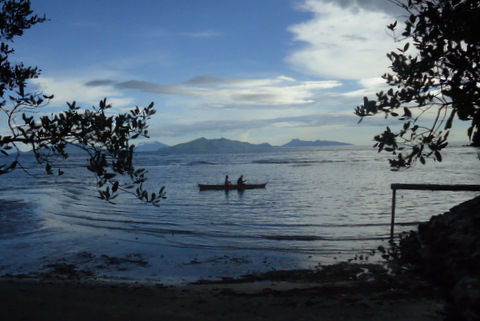
Our trike driver (who, in the next few days, would give us a tour around his 'hood, pointing out his mom's house and other significant places) took us to a beach called Baot. We tried several others before coming here, but none the huts were available for rent anymore (one had animals living in it). This was about 20 to 30 minutes from the airport. It would take an hour's walk to the main road.

We had instructed him to take us to a hut. We were harboring dreams of working from a hut for a week while listening to the waves.


A swing made from driftwood.


Baot has a beautiful view of a mangrove flat. One family inhabited this shoreline, and it was a draw for very local beachgoers (this means teenagers cutting class, or people from nearby barangays renting huts to eat and drink in for the day).


Our deluxe hut.

There was an overnight hut, available for 200 pesos a night. It had a receiving room and a "master's" bedroom. Oddly, the whole floor area, save for the restroom, was covered in old carpeting. And the bedroom walls, presumably to dissuade little children from peeping into the holes that occur in natural building material, were covered by flapping curtains with poinsettia print.


To be in a room of synthetic poinsettia fabric is an experience in itself.

Now, if you are looking for basic huts along uninhabited beaches, always remember that locals have dibs on defining entertainment for that area. And that means videoke-- lots of it.

06 June 2011

Calbayog Airport Carinderia


The carinderia table usual suspects: utensils, tissue, salt, pepper, fish sauce.


Where to gather information about a place before venturing out? We always check out local carinderias, coffee shops, or the type of restaurant that has "regulars" (or, in other settings, tables with assortments of events flyers or local papers) before venturing out into a completely strange place. This is because, when you buy a meal (or even a rice cake) from someone, you are automatically granted the right to ask questions without being a pest.


The very helpful lady we pestered at our first stop.

In addition, by asking peripheral questions, you get a better idea of the context that now surrounds you.

By the extreme curiosity drawn forth by our mere arrival in Calbayog, it was apparent that tourists were not arriving in droves. The rental of this relatively large carinderia space was 1,500 pesos a month (approximately 35 US dollars). Save for us, there were 3 other people eating, all airport personnel. This was not going to be your bustling semi-city.


A handwritten ad for an "open university".


Chicken tinola made with backyard fowl.

Rob ate his chicken tinola-- made with the "native" chickens that are less meaty but make for a tastier broth-- as the waitresses chattered away, giving us suggestion upon suggestion. It was a relaxing atmosphere, sunlight coming through the windows, which were decorated with amazing strung folded pieces of plastic straws and cigarette wrappers, something the women did to keep themselves occupied when there was nothing else to be done.


Handmade decor, repurposed plastic packaging.


Cigarette wrappers and straws, closer.


Repurposed C2 bottles, serving as hanging planters.

I was distracted by the ornamentation of the place. I love carinderia decor because it is honest. I don't mean to sound trite, but the conceptions of beauty are very simple.


The owner of the carinderia is named Ortiz, we gathered.

Eventually, the waitresses told us to go to a certain beach where we could find cheap huts for rent. One of the waitresses took us aside and whispered the standard tricycle price, to prevent us from getting ripped off. As we contracted the services of one tricycle driver (which one diner had hollered for across a hundred feet), all waitresses stood observing, like guardians of the proper fare range. There is no standard fare in Calbayog for anything, by the way. There is only you, the driver, and the moment you are sharing. Speak quickly, and fairly.

Popular Posts